Indent explores the codebase, plans the change, edits the code, runs linters and tests, and opens a pull request. You watch each step as it happens: which files it read, what it edited, and what commands it ran. Click an edit to open its diff beside the transcript.
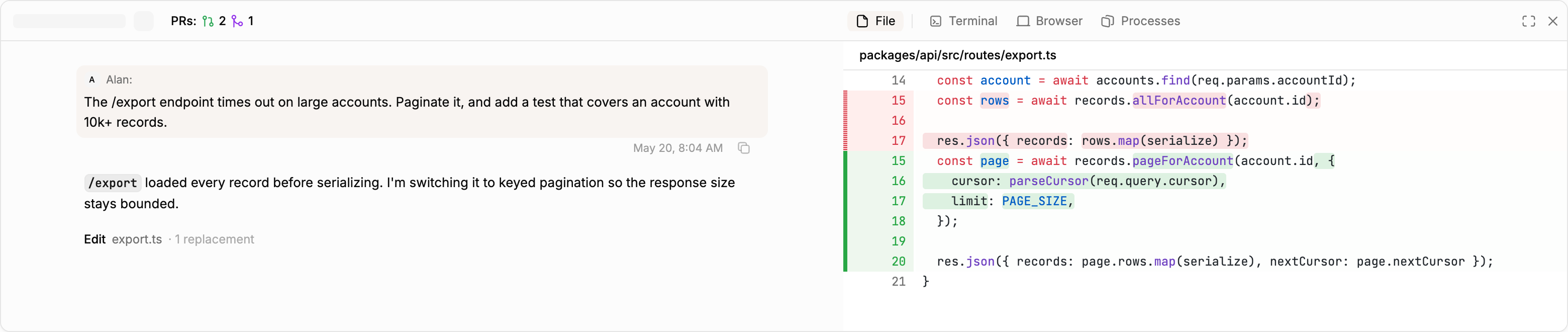
From prompt to pull request
Describe a bug, feature, or task in a session. Indent reads files, searches for references, and runs commands to understand the codebase, then makes the change, verifies it, and opens a pull request.
For example:
@indent The
/exportendpoint times out on large accounts. Paginate it, and add a test that covers an account with 10k+ records.
Indent runs in a fresh sandbox with your repository cloned, plus a shell and a browser. It has your code but not your build — dependencies aren’t installed and services aren’t running. Some tasks need your application built and running: the full test suite, a live service, or the UI in a browser. For those, start the session in an environment you’ve configured, where everything is ready from the first message.
Iterate in the session and on the pull request
The session stays connected to the pull request it opens, so you can keep working on the change:
- Review comments — a teammate’s comment on the pull request routes back to the session. Reply
directly in an inline thread and Indent responds without a mention; in a top-level comment,
mention
@indent. - CI failures — a failing check comes back to the session, where Indent reads the logs, decides whether the failure relates to the change, and pushes a fix.
- Your follow-ups — a message in the session refines the approach or redirects the work. If the session has suspended, a new message resumes it.
What Indent can build
- Bug fixes — Indent reproduces the issue, traces the root cause, fixes it, and verifies.
- Features — Indent scaffolds new functionality, wires it into existing code, and runs tests.
- Infrastructure and configuration — Indent edits CI pipelines, Dockerfiles, and deployment configs.
- Assets and non-code files — Indent edits SVGs, config files, migration scripts, and anything else in the repository.
Give Indent more to work with
The more Indent knows about your codebase, the better its changes fit:
- AGENTS.md: repository guidance kept with your code. Local desktop sessions load it automatically; in cloud sessions, ask Indent to read it.
- Skills — reusable workflows Indent pulls in when a task matches.
- Connected databases — schema and data Indent can query while it works.
For more on framing tasks well, see Getting good results from Indent.